
RTHK CIBS · 非遗「武」道館 · EPISODE 4 · 21 APRIL 2026
Listen to the original episode on RTHK: rthk.hk · 第四集 遗走筆墨與武術之間
Please find the transcript of the episode at the end of the article
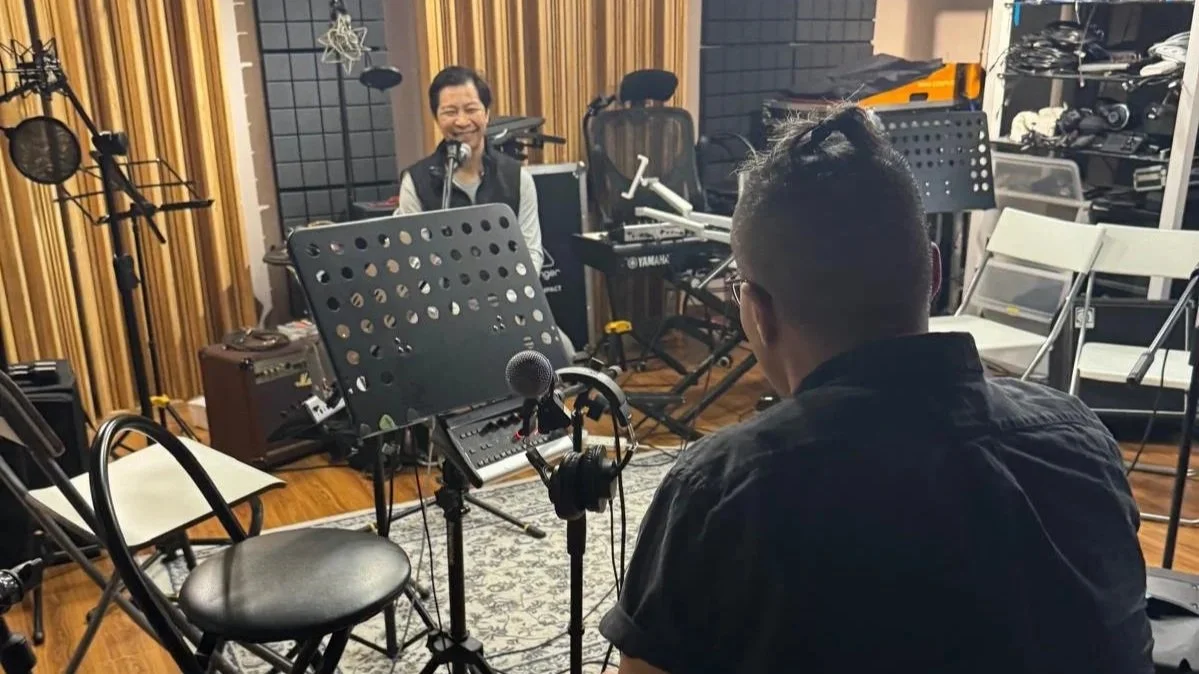
The fourth episode of RTHK’s 非遗「武」道館 (Intangible Cultural Heritage Martial Arts Hall) carries a title that fits its guest perfectly: 遗走筆墨與武術之間, which translates as “Wandering Between Ink-Brush and Martial Arts.” Yeung Sifu (楊一帆) is a practitioner of Wu-style Tai Chi, a student of the Cangzhou Tongbei and Pigua Tongbei traditions, a calligrapher, and a postgraduate scholar. In this episode, host Gil invites him to reflect on all of it.
The conversation covers the contested origins of Tai Chi, the martial philosophy behind “control technique,” the three traditional weapons of the Wu family, and what it takes to transmit a classical art in a city as time-pressed as Hong Kong. What follows is an English translation of the key moments, produced so that English-speaking readers can access the conversation.
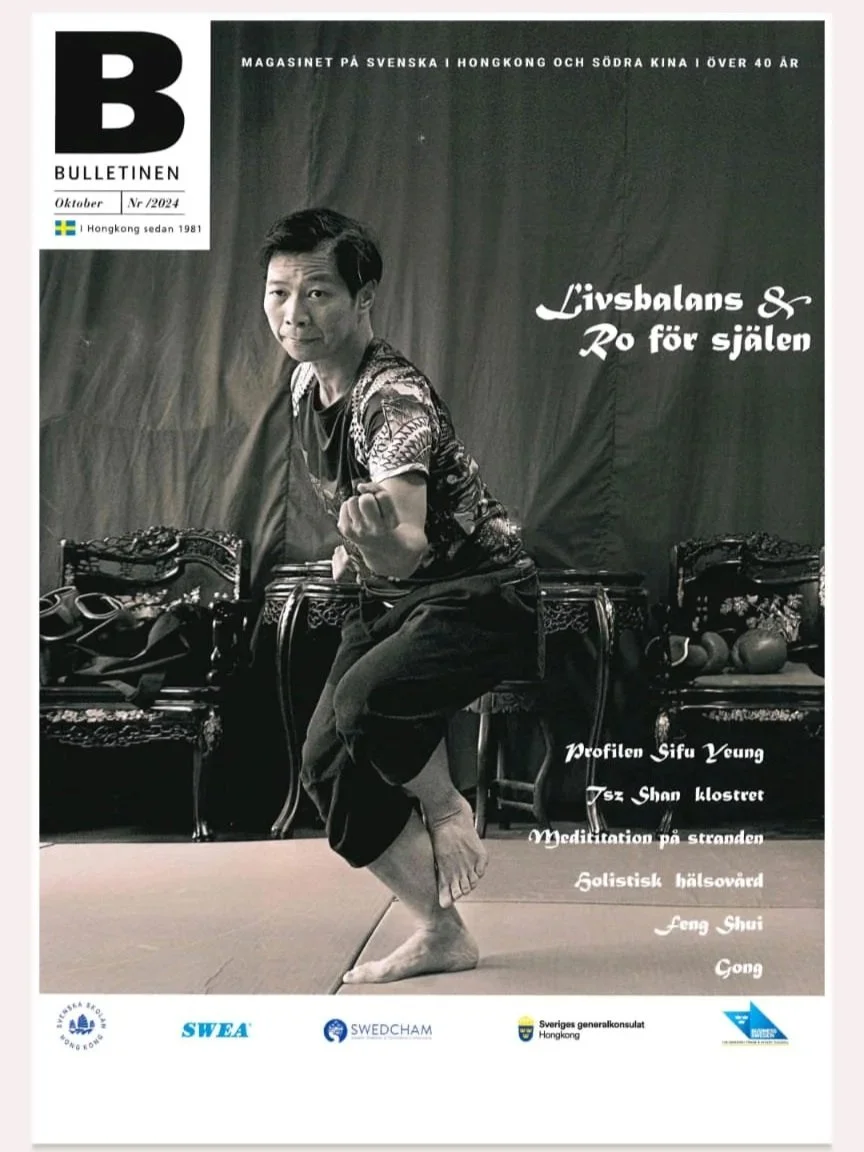
Yeung Sifu’s interview feature in the Hong Kong Swedish Chambers magazine 2025
A Journey That Began in Sweden
Yeung Sifu’s path into martial arts is anything but conventional. At thirteen, he emigrated from Hong Kong to Sweden with his family. In Sweden he encountered his first serious teacher: a Hong Kong sifu who introduced him to the Southern kung fu tradition of Bamboo Forest Temple Mantis (笹林寺螳蝶). Studies eventually took priority and the practice faded, but the seed had been planted.
After returning to Hong Kong as a university graduate, he sought out two teachers who would shape the rest of his martial journey. Sifu Chan brought him into Tai Chi. Sifu Zhu Xiaotian (祝笑天) introduced him to Tongbei Quan. Different traditions, but the same serious pursuit.
contested Origins of Taichi
Ask about the “authentic” origins of Tai Chi on mainland Chinese martial arts forums and you will ignite a debate that has burned for decades. Yeung Sifu addresses it directly, and with a refreshing evenhandedness.
Yang-style Tai Chi is attributed to Yang Luchan (楊露禪), who studied under Chen Changxing (陳長興) in the Chen family village of Chenjiagou. Chen Changxing himself had teachers, among them Jiang Fa (蒋發), whose own origins remain disputed. After so many generations of transmission and adaptation, tracing a single unbroken line becomes nearly impossible.
“Everyone just follows what their own sifu, and their sifu’s sifu, passed down. After all these generations, it is very hard to say with certainty what it was back then.”
What he is willing to say with confidence is that Yang-style and Wu-style are essentially “brother arts.” Their foundational principles, training philosophies, and many of their core forms share a common ancestry. The visible differences in frame size, footwork, and posture alignment are matters of refinement and emphasis, not of different underlying philosophy.
Reading a Practitioner at a Glance
One of the more enjoyable passages in the episode is when Yeung Sifu explains how an experienced eye can identify a practitioner’s lineage almost immediately. The answer lies in the frame.
Contemporary Tai Chi divides broadly into large (大架), medium (中架), and small (小架) frames. Yang-style favours a wider, more expansive middle frame. Wu-style uses the 川字步, a narrower stance with toes pointing forward that resembles natural walking, with less pronounced horse stances and a characteristic slight forward lean of the torso.
Quick reference on identifying Tai Chi styles by frame: Wu-style uses the 川字步, with parallel feet, toes forward, a narrower stance, and a subtle forward lean. Yang-style favours wider, more expansive postures. Sun-style shares Wu’s compact frame but incorporates active follow-step footwork. Chen-style is the most visually dynamic, featuring silk-reeling movement and bursts of explosive 發勁 (fa jing).
Four Ounces Move a Thousand Pounds
The episode takes its most compelling turn when host Gil raises the challenge that follows Tai Chi everywhere: “People say it looks beautiful but is useless in a real fight. What do you say to that?”
Yeung Sifu’s answer reframes the whole question. Most martial discussions, he points out, focus on just two dimensions, attack and defence, while overlooking a crucial third: control technique.
External styles tend to meet force with force, hard against hard, strike and advance. Tai Chi operates on a different principle entirely. The classical expression is 引進落空,四兩撥千斤: draw in to create emptiness, and four ounces redirect a thousand pounds. Through push hands (推手) and the sensitivity practice of listening energy (聽勁), a practitioner learns to read and redirect an opponent’s centre of gravity rather than clash against it.
“Martial arts has attacking technique and defending technique. But in between there is controlling technique, and that is where Tai Chi is exceptional.” - Yeung Sifu, Episode 4
For those practicing Tai Chi primarily for health, this martial dimension rarely gets explored. But it is, Yeung Sifu insists, the heart of what the art was always designed to be: a sophisticated system of body mechanics, sensitivity, and timing, not merely slow and graceful movement.
The Three Treasures of the Wu Family
Beyond the empty-hand forms, traditional Wu-style Tai Chi preserves three core weapon disciplines known as the 吳家三寶, the three treasures of the lineage:
拳 Bare Hand (Quan): The foundation of the system. Every student begins here, regardless of their goal.
劍 Sword (Jian): The most widely practiced weapon, light and precise, closely aligned with Tai Chi’s core principles.
刀 Broadsword (Dao): The most physically demanding of the three. Less commonly taught and not required for health-focused practice.
For students approaching Tai Chi as a wellness practice, the barehanded forms alone are entirely sufficient. The weapons tradition matters most for those pursuing a deeper martial understanding of the underlying principles.
Teaching in a City That Never Slows Down
"Yeung Sifu's first question to every new student: what do you actually want from this practice?"
Hong Kong presents a particular challenge for traditional martial arts instruction. Time is the city’s scarcest resource. Students fit practice into evenings and weekends, rarely achieving the sustained daily immersion that deep training demands. “To do it properly, covering foundation work, body method, and then application, you are talking about years,” Yeung Sifu says. “That is difficult in Hong Kong.”
Paradoxically, overseas students often bring the most sustained commitment. Through an English-language website, Yeung Sifu regularly hears from practitioners in Europe and North America, many of whom are willing to fly to Hong Kong for an intensive week or two of study, or to continue learning via online lessons. “Foreigners often have enormous passion for Chinese martial arts,” he observes. “Sometimes more than people who grew up right here.”
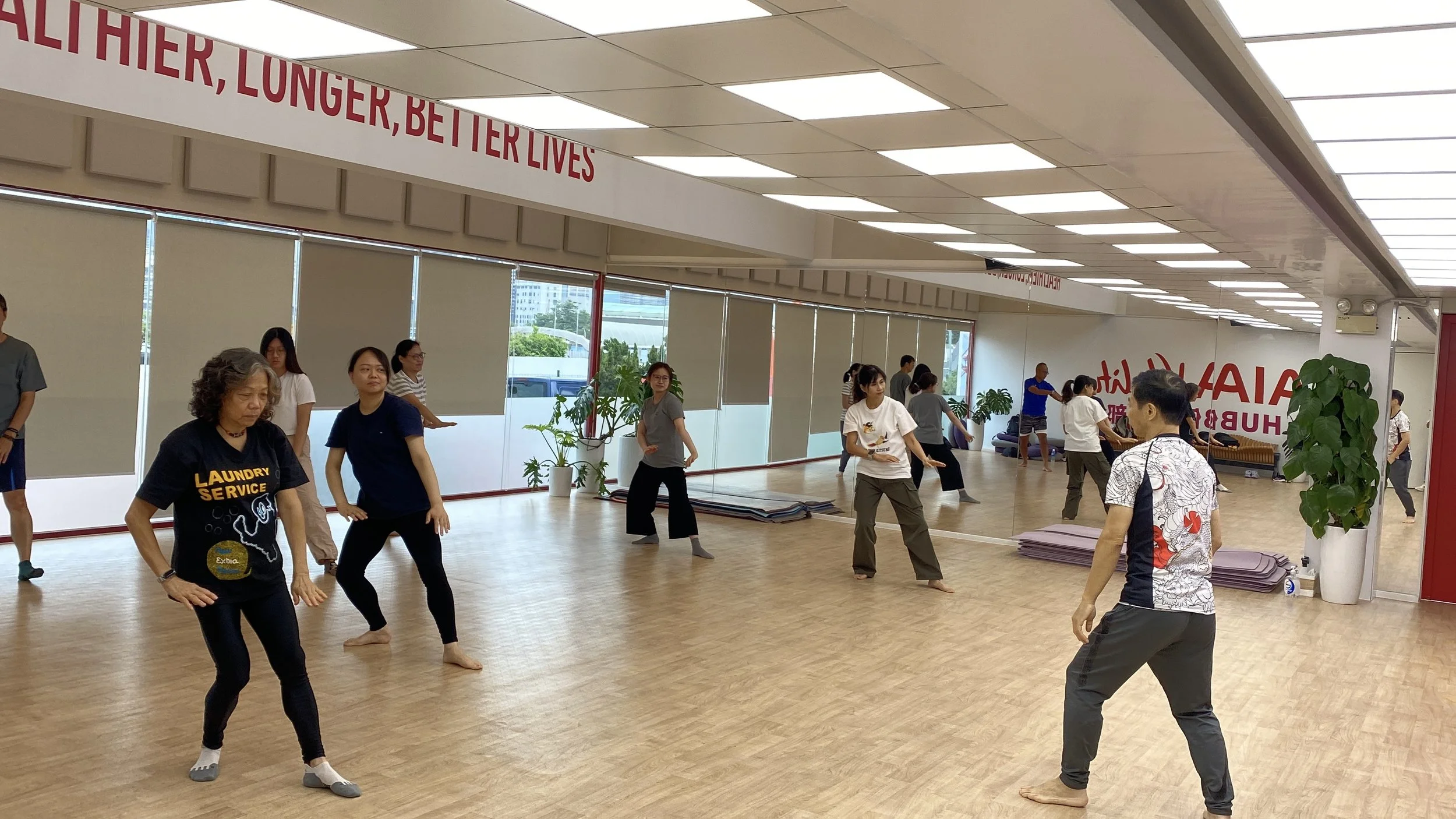
His teaching approach is adaptive from the start. Before anything else, he asks what a student actually wants. Someone seeking gentle movement and better health needs a fundamentally different approach from someone chasing martial depth. The forms may look identical on the surface. The coaching is entirely different underneath.
Transmission is Culture, Not Just Choreography
The episode closes on the question that sits at the heart of the entire 非遗「武」道館 series: what does it truly mean to pass a living art to the next generation?
For Yeung Sifu, transmission is never merely the handover of a sequence of movements. It is the transfer of a worldview rooted in the Taoist principle of 自然 (naturalness): the understanding that force should flow rather than crash, that sensitivity ultimately outweighs strength, and that every movement should arise from a deeply felt understanding of the body, of space, and of another person.
That philosophy, cultivated across years of practice and deepened by a life in calligraphy and literature, is what gives the art its living quality. It is precisely what cannot be captured in a YouTube tutorial.
Listen to the full episode in Cantonese on RTHK: 第四集 遗走筆墨與武術之間 · RTHK 普通話台 CIBS
The transcript below has been generated using AI and may contain inaccuracies. Please refer to the original radio broadcast for accuracy.
以下文字記錄由人工智能生成,內容可能有不準確之處。請以原電台廣播內容為準。
主持人:即使門派唤唆,但我們志同道合。
Host: Even though the sects are different, we are like-minded.
非遗武道館。歡迎大家實到香港電台 CIBS 節目《非遗武道館》,我係大家嚇的節目主持人阿 Gil。
Intangible Cultural Heritage Martial Arts Hall. Welcome to the CIBS programme on Radio Hong Kong. I am your host, Gil.
每一集我們都會邀請唤唆門派嚇的武術宗師、武術傳人或者武術教育者上實分享。今日我們就邀請咋一位……佢唤單止喺武術方面有深厚造詣,亦都有學習太極,亦都有滄州通臂或者劈挂通臂嚇手法。另外佢自己除咋武術之外,都有教毛筆(書法),亦都係碗士生,即係腹有詩書氣自華。
In each episode we invite martial arts masters, successors, or educators from different schools to share. Today's guest is a man of many disciplines: deep in martial arts, learned in Tai Chi, practised in Cangzhou Tongbei and Pigua Tongbei, a calligraphy teacher, and a postgraduate scholar. As the saying goes, one whose belly is full of poetry and literature radiates an effortless grace.
歡迎今日嚇嘉賓——楊一帆楊師傍!
Welcome today's guest, Master Yang Yifan!
【楊師傍自我介紹】
楊師傍:多謝主持人。我十三、四歲嗅陣時跟家人移民去瑞典,喺嗅山讀書,大學畢業之後返實香港工作。
Yeung Sifu: Thank you host. When I was thirteen or fourteen I emigrated to Sweden with my family, studied there, and returned to Hong Kong to work after graduating from university.
早年我好早就接觸武術,小學嗅陣時已經喺學校參加柔道班,有初步接觸。後來到中學,喺瑞典認識一位香港師傍,跟佢學南派功夫(笹林寺螳蕶)。學咋一段時間覺得有趣,但因為要繼續學業就冗签山囉。
I was exposed to martial arts from a young age, joining judo classes at primary school. Later in secondary school, in Sweden, I met a Hong Kong sifu and learned Southern kung fu, specifically the Bamboo Forest Temple Mantis style. I studied for a while and found it interesting, but my studies took priority and I did not practise as diligently as I should have.
返香港之後,我就再搛師傍學習,主要有兩位:一位係陳師傍(太極拳),另一位係祝師傍(祝笑天師傍),跟佢學通臂拳。祝師傍而家主要教八極拳。
After returning to Hong Kong I sought out two main teachers: Sifu Chan for Tai Chi, and Sifu Zhu Xiaotian for Tongbei Quan. Sifu Zhu now primarily teaches Bajiquan.
【太極拳歷史來源】
主持人:今日主要想講下太極……你所學習嚇太極就吴式太極囉……
Host: Today I mainly want to talk about Tai Chi. The style you practise is Wu-style Tai Chi...
楊師傍:呢個係一個好大嚇話題。內地好多人討論正宗問題,但其實牽涉好多歷史文化背景,好難短時間有確實證據。大家都只係跟住自己師傍、師公所講,或者自己傳承去理解。
Yeung Sifu: This is a very big topic. Many people on the mainland debate questions of authenticity, but these involve a great deal of historical and cultural background, and it is difficult to find conclusive evidence in a short time. Everyone simply follows what their own sifu and their sifu's sifu have passed down, or understands through their own lineage.
楊式太極係由楊露禪創立,佢去陳家溝跟陳長興學藝。但陳長興自己都有其他師傍(例如蒋發)。所以楊露禪學嚇功夫,部分可能係(源於)陳家溝本身,部分可能係其他傳承。經過咋多代,而家好難話當年究竟係點。
Yang-style Tai Chi was founded by Yang Luchan, who went to Chenjiagou to study under Chen Changxing. But Chen Changxing himself had other teachers, including Jiang Fa. So the kung fu that Yang Luchan learned may have partly originated from Chenjiagou itself, and partly from other lineages. After so many generations, it is now very difficult to say what things were like back then.
楊家同吴家基本上係兄弟拳,好多拳譜(嚇內容)都係共通嚇。
The Yang family and the Wu family are essentially brother arts, and many of their foundational forms share common content.
【架式分別】
楊師傍:現今太極拳從架式上可以分大、中、小架。小架如吴式、孫式;大架步幅度大,楊式比較強調中架或者高中架,(吴家)用川字步,膳尖向前,類似正常行路咋。馬步喗咋大。
Yeung Sifu: Today's Tai Chi can be divided by frame into large, medium, and small. Small frame includes Wu-style and Sun-style. Yang-style emphasises the middle or higher-middle frame with wider stances. Wu-style uses the 川字步 (Sichuan character step) with toes pointing forward, similar to normal walking. The horse stance is not as wide.
一眼望過去,大致可以分辨到對方笷緊邊一派。
At a glance, you can generally tell which school the other person is practising.
【太極好睿但喗用?實戰價値】
主持人:好多人講太極好睿但喗用,尤其去到實戰……
Host: Many people say Tai Chi looks good but is useless, especially when it comes to real combat...
楊師傍:而家一般人笷太極主要係為養生,呢點喗得否認。但古代或者前幾代,佢們都係有自衛、實戰嚇需要。
Yeung Sifu: Nowadays most people practise Tai Chi primarily for health. That cannot be denied. But in ancient times and in previous generations, they had real needs for self-defence and combat.
太極最特別之處係「控制技術」。一般外家拳多數係硬打硬進,但太極強調「引進落空、四兩撥千斤」,透過推手、聽勁去控制對方重心同距離。呢種技擊方式係更高階嚇。
The most special thing about Tai Chi is its "control technique." External styles mostly meet force with force, hard against hard. But Tai Chi emphasises drawing in to create emptiness and redirecting a thousand pounds with four ounces, through push hands and listening energy, to control the opponent's centre of gravity and distance. This approach to combat is of a higher order.
武術有進攻技術、防守技術,中間他有控制技術,太極就特別強喺呢一方面。
Martial arts has attacking technique and defending technique, and in between there is controlling technique. Tai Chi is particularly strong in this area.
【兵器】
主持人:除拳術之外,太極有喗需要學兵器?
Host: Apart from empty-hand forms, is there a need to learn weapons in Tai Chi?
楊師傍:傳統有吴家三寶:拳、刀、劍。太極劍比較多人笷,太極刀就少啊,因為刀比較辛苦。若果純粹養生,就唤唆一定要笷刀。
Yeung Sifu: Traditionally there are the three treasures of the Wu family: fist, broadsword, and sword. The Tai Chi sword is more widely practised; the Tai Chi broadsword less so, because it is harder work. If you are practising purely for health, you do not necessarily need to practise the broadsword.
【傳承與教學】
楊師傍:教學生最重要係先了解佢想要亞麼。有人只想做運動、養生,有人想深入學習,教法就要調整。
Yeung Sifu: The most important thing in teaching students is first understanding what they want. Some only want exercise and health maintenance, while others want to study in depth. The teaching method must be adjusted accordingly.
傳統武術要由基本功開始,笷身法、提升動作質素,再到應用,係需要以年計嚇過程。香港人時間有限,比較困難。反而外國人對中國武術熱誠好大,好多人專程實香港跟住我學。
Traditional martial arts requires starting from the basics, training body method, improving movement quality, and then moving to application. It is a process measured in years. Hong Kong people have limited time, which makes it more difficult. Foreigners, on the other hand, often have great passion for Chinese martial arts, and many travel specifically to Hong Kong to study with me.
我而家有英文國際網站,常有外國人聯絡,想實學一兩個星期或者上網課。
I now have an English international website, and I am often contacted by foreigners who want to come and study for a week or two, or to take online lessons.
【傳承理念】
楊師傍:傳承唤唆只係教動作,仒要傳文化同精神,包括「自然」嚇理念。
Yeung Sifu: Transmission is not only about teaching movements. It is also about passing on culture and spirit, including the principle of naturalness (自然).
(文字稿於此結束。)
